
Case Study: How Grade 3 Gynecomastia Changes the Surgical Plan on a Larger Frame
A Larger Frame Made This Case More Complex
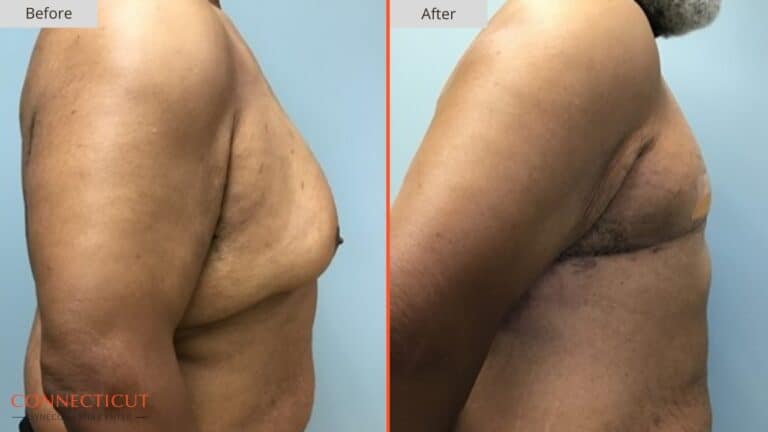
This patient came to us with Grade 3 gynecomastia, one of the more advanced stages of the condition. On a larger frame, this grade of gynecomastia often creates a chest that projects forward noticeably, even through clothing. That projection was clear in the before photo, where the chest extended well past the natural line of the body.
Grade 3 gynecomastia is not just about extra tissue. It involves a mix of excess glandular tissue, fat, and often some loose skin. On a bigger frame, this combination tends to be more pronounced, since there is simply more tissue for the condition to affect. This patient’s case called for a plan that could address all of these layers at once.
Why Grade Matters When Planning Surgery
Gynecomastia is usually broken into grades based on how much tissue is present and how much the skin has stretched. Grade 1 involves a small amount of extra tissue. Grade 3 involves significant enlargement and often some skin laxity. This patient’s Grade 3 diagnosis meant a more involved surgical approach was needed compared to a milder case.
We do not treat every gynecomastia case the same way. Since this patient’s chest showed heavy tissue volume along with a fuller, larger frame, our surgeon combined two techniques rather than relying on just one. This is a common approach for higher-grade cases, since a single method rarely addresses both the dense glandular tissue and the surrounding fat.
Combining Excision and Liposuction for a Full Correction
Our surgeon used a combination of tissue excision and liposuction to treat this patient. Excision involves surgically removing the firm glandular tissue that liposuction alone cannot break down. This tissue tends to feel dense and rubbery, and it sits directly behind the nipple in most gynecomastia cases.
Liposuction, on the other hand, targets the softer fatty tissue that surrounds the gland. Removing this fat helps blend the chest into a flatter, more natural shape once the denser tissue has been excised. Using both techniques together allows the chest wall to be reshaped from multiple angles, not just flattened in one spot.
For a larger frame like this patient’s, this combination becomes especially important. Since more tissue volume was present, liposuction alone would likely have left behind firm tissue that could still be felt or seen under the skin. Excision alone might have addressed the gland but left surrounding fat that kept some fullness in place. Together, the two techniques allowed our surgeon to reduce volume and reshape the chest wall in the same procedure.
What the Profile View Reveals
The before and after photos for this patient were taken from the side, which is one of the clearest ways to evaluate a gynecomastia result. A profile view shows chest projection more honestly than a front-facing photo, since it captures how far the chest extends from the body.
In the before photo, this patient’s chest projected outward in a way that was difficult to conceal under clothing. This is common with Grade 3 cases on larger frames, since the added tissue volume has more room to build outward rather than staying flat against the chest wall.
In the after photo, that projection is gone. The chest now follows a much flatter line that matches the natural contour of the body. This kind of change is exactly what we look for when evaluating a successful gynecomastia result on a larger frame. Since flattening the chest wall was the primary goal for this patient, the profile view gives the clearest evidence of how much was corrected.
The Result for This Patient
This patient’s result shows a chest that sits close to the body with none of the forward projection seen before surgery. The combination of excision and liposuction addressed both the dense tissue and the surrounding fat, which is what allowed for such a complete change in a single procedure.
Results like this are typical when a surgical plan matches the severity of the case. A Grade 3 diagnosis on a larger frame requires a more thorough approach, and this patient’s outcome reflects that. The chest wall contour restored here would not have been possible with a single technique on its own.
Considering Treatment for Grade 3 Gynecomastia
If you are dealing with a chest that projects outward despite diet and exercise, you may be facing a higher grade of gynecomastia. This is especially common on larger frames, where excess tissue has more room to build. A thorough evaluation can determine your grade and the right combination of techniques for your body.
Contact Connecticut Gynecomastia Center to schedule a consultation. We can walk you through what your case may involve and what a customized surgical plan could look like for your body type.