
Case Study: Managing Severe Skin Excess in an Advanced Gynecomastia Case

A Case Defined by Tissue Overgrowth and Sagging
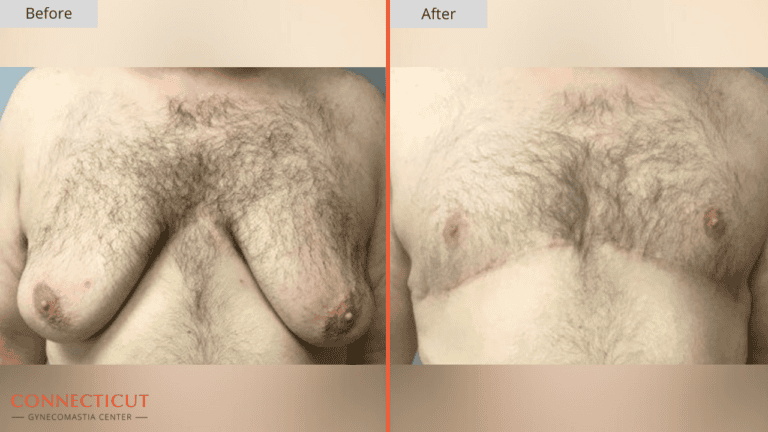
This patient came to us with Grade 4 gynecomastia on a large frame. This is one of the most advanced stages of the condition. The before photo shows severe tissue overgrowth along with visible sagging across both sides of the chest.
This combination of overgrowth and sagging is what sets Grade 4 apart from earlier grades. It is not just about extra tissue sitting on the chest. The skin itself has stretched to accommodate that tissue over time, which changes how the correction needs to be approached.
Why Sagging Skin Changes the Surgical Plan
In earlier grades of gynecomastia, the skin usually keeps enough elasticity to settle back into place once the excess tissue is removed. That is not always true in advanced cases. Once tissue has built up for long enough, the skin can stretch past the point of bouncing back on its own.
This patient’s chest showed that kind of stretching. The weight of the tissue had pulled the skin downward, creating a sagging appearance rather than a simple rounded fullness. Since the description notes this weighed on the patient both physically and emotionally, it is clear how much of a daily impact this condition had.
Removing the tissue alone would not have been enough to correct this. Without addressing the loose skin left behind, this patient would have been left with a flatter chest that still hung or sagged. That is why our surgeon built a plan around three separate steps rather than one.
Combining Gland Removal, Liposuction, and Skin Tightening
Our surgeon addressed this case with extensive gland removal, liposuction, and skin tightening. Each of these steps plays a different role in a severe case like this one.
Gland removal targets the dense glandular tissue that sits close to the nipple. This tissue does not respond to diet, exercise, or liposuction on its own since it is not fat. Liposuction then removes the surrounding fatty tissue, which helps smooth out the chest once the denser gland tissue is gone.
Skin tightening is the step that separates advanced cases like this one from milder ones. Once the tissue is removed, our surgeon trims and repositions the excess skin so it can sit flat against the newly flattened chest wall. Without this step, the skin would remain loose even after the tissue underneath is gone.
Why This Case Required All Three Techniques Together
Severe cases like this one show why a single technique is rarely enough. If our surgeon had only performed liposuction, the dense gland tissue and stretched skin would have remained. If gland removal had been done without skin tightening, this patient would have been left with excess skin that no longer had tissue to support it.
Using all three techniques together allowed our surgeon to correct the tissue overgrowth and the skin laxity in the same procedure. This is a common approach for Grade 4 cases, since the condition affects more than just the volume of the chest.
The Result for This Patient
The after photo shows a dramatic change from where this patient started. The chest now sits flat against the body with no visible sagging or overhang. The skin that once stretched to accommodate the excess tissue now fits the new chest contour.
This result reflects how much a thorough surgical plan matters in advanced cases. Cases like this show that even Grade 4 gynecomastia can be corrected with a flatter, more natural chest profile when gland removal, liposuction, and skin tightening are used together.
Treatment for Advanced Gynecomastia
If you are dealing with significant chest overgrowth or sagging that has not improved on its own, you may be facing a more advanced form of gynecomastia. These cases often need more than one technique to fully correct, but that does not mean a flatter chest is out of reach.
Contact Connecticut Gynecomastia Center to schedule a consultation. We can evaluate your case and explain what a complete surgical plan could look like for your body.