
Case Study: Why Liposuction Alone Would Not Have Been Enough for This Chest
Liposuction gets a lot of attention as a fix for a fuller chest. For many men researching gynecomastia, it is the first procedure that comes to mind. This patient’s case is a good example of why liposuction on its own often is not enough.
A Chest Wall That Pushed Forward, Not Just Out
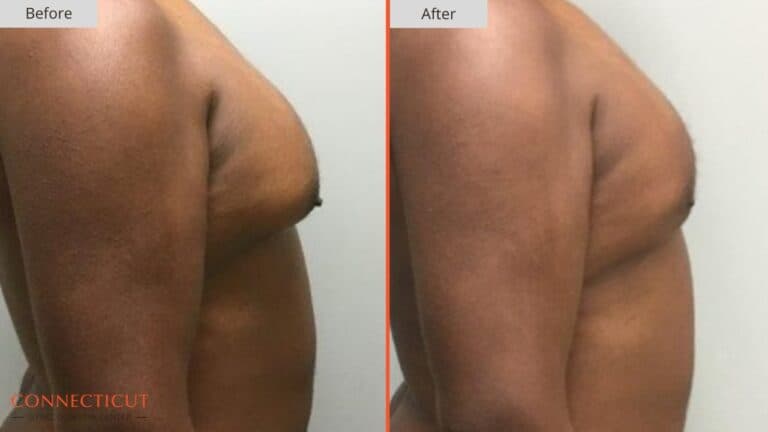
This patient came to us with Grade 3 gynecomastia on a large frame. The chest wall projected clearly forward from the body, a hallmark of this grade. That kind of projection is different from a chest that simply looks fuller or wider. It means the tissue has built outward from the ribcage rather than spreading across the surface.
This distinction matters because it points to what kind of tissue is driving the shape. A chest that is full but flat against the body often has more fat involved. A chest that projects forward, the way this patient’s did, usually has a firmer glandular component sitting behind it.
Why Fat and Glandular Tissue Are Not the Same Problem
Liposuction is built to remove fat. It works through a thin cannula that breaks up and suctions out fatty tissue, and it does this well when fat is the primary issue. But gynecomastia is rarely just fat. Most cases involve a firm gland that sits directly behind the nipple, and that gland does not respond to suction the way fat does.
If our surgeon had used liposuction alone on this patient, the fatty tissue around the gland would have come out, but the dense core driving the projection would have stayed in place. The chest might have looked slightly smaller, but the forward push seen in the before photo would have remained largely unchanged.
What Tissue Removal Adds to the Correction
Our surgeon addressed this case with tissue removal combined with liposuction, not liposuction on its own. Tissue removal involves surgically excising the glandular tissue through a small incision, usually along the edge of the areola. This step targets exactly the part of the chest that liposuction cannot reach.
For this patient, removing that glandular core was what allowed the chest wall to actually change shape rather than just shrink in size. Liposuction then smoothed the surrounding fat once the firmer tissue was gone, which is what let the chest settle into a flatter line overall.
Reading the Result Against What a Lighter Approach Would Have Given
The after photo shows a chest that sits much closer to flat against the body. That result reflects the combined approach, not a single technique working in isolation. Had this patient pursued liposuction alone, a common assumption for many men looking into treatment, the outcome would likely have looked like a smaller version of the same projected shape rather than a true correction.
This is one of the more common misunderstandings we see in men researching gynecomastia treatment. Liposuction is a real part of many surgical plans, but it plays a supporting role in cases like this one rather than doing the work on its own.
Why the Right Technique Matters More Than the Right Amount of Suction
Chest correction is not just about how much tissue comes out. It is about which tissue comes out and how. This patient’s case shows that a chest with real projection needs a plan built around removing the structural cause, not just reducing volume.
If your chest projects outward and you have wondered whether liposuction alone would fix it, this case is worth considering. A proper evaluation can tell you whether your chest involves gland tissue, fat, or both, and what combination of techniques your case actually needs.
Connecticut Gynecomastia Center can walk you through that evaluation and build a plan around what your chest requires, not a one-size-fits-all approach. Reach out to schedule a consultation.