
Case Study: Understanding “Puffy Nipple” Gynecomastia and How It Differs From Other Cases

Not all gynecomastia looks the same, even at similar grades. Some cases involve real sagging and excess skin. Others create a rounded, puffy appearance without any drooping at all. This patient’s case falls into that second category, sometimes described as “puffy nipple” gynecomastia.
A Puffy Look, Not a Sagging One
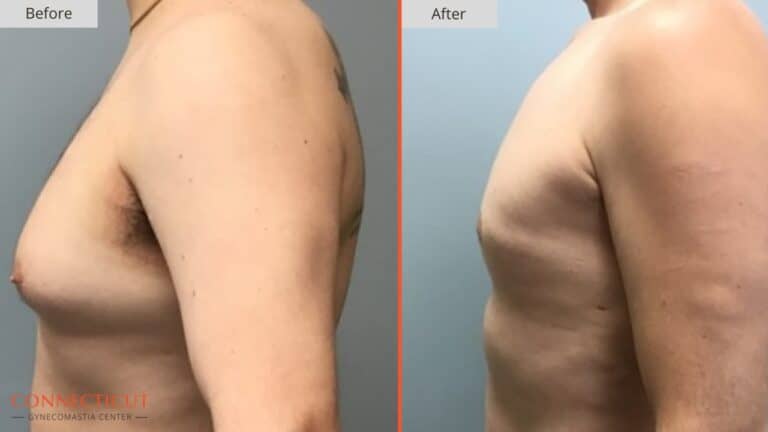
This patient had Grade 2 gynecomastia with moderate gland tissue. Rather than causing the chest to sag or droop, the tissue built up directly behind the nipple, creating a rounded, puffy appearance when viewed from the side. There was no significant skin excess and no true ptosis involved.
This distinction is important because puffy nipple gynecomastia and sagging gynecomastia are treated with different priorities in mind. A sagging case often needs skin removal or repositioning in addition to tissue removal. A puffy case, like this one, is usually about removing the tissue causing the roundness without needing to correct excess skin.
Why the Tissue Sits Where It Does
The gland tissue behind the nipple tends to concentrate in a fairly specific area rather than spreading evenly across the chest. This is why puffy nipple cases often show a distinct raised or rounded shape right at the nipple, rather than a general fullness across the whole chest.
For this patient, that concentrated tissue was what created the puffy look seen in the before photo. The rest of his chest followed a fairly normal contour for his build. It was really this one localized area driving the appearance he wanted addressed.
A Direct Removal With a Clean Outcome
Our surgeon removed the excess gland tissue directly, targeting the area behind the nipple where it had built up. Since there was no significant skin laxity to manage, this case did not require the additional steps that a sagging or advanced case would need, like skin tightening or extensive liposuction.
This more contained approach reflects how the surgical plan matches what the tissue is actually doing. Puffy nipple cases like this one tend to respond well to direct tissue removal because the fix is localized. Once the tissue behind the nipple is gone, the puffy appearance goes with it.
What “Blending Naturally” Actually Means
The goal in a case like this is not just to make the chest flatter. It is to make the chest look like it belongs to this patient’s body, rather than looking like something was clearly done to it. That is a harder standard than volume reduction alone.
In the after photo, this patient’s chest wall shows no visible projection at all. The nipple sits flat against the chest, and the surrounding contour matches the rest of his build without looking altered or uneven. This is what a clean result looks like when the case is caught before sagging or skin excess become part of the picture.
Why Catching It at This Stage Matters
Puffy nipple gynecomastia is often easier to correct fully than more advanced cases, partly because there is less to reverse. Skin that has not stretched does not need to be tightened. Tissue that has not built up extensively does not need to be paired with liposuction to smooth out a larger area.
This patient’s result is a good example of what a more contained case can achieve. The correction is thorough, but the plan behind it was simpler because the condition had not progressed into sagging or major skin excess.
If your chest has a rounded or puffy look around the nipple rather than a drooping appearance, that distinction matters for how your case would be treated. Connecticut Gynecomastia Center can help you understand which type of gynecomastia you are dealing with and what a plan built around your specific tissue pattern would look like. Reach out to schedule a consultation.